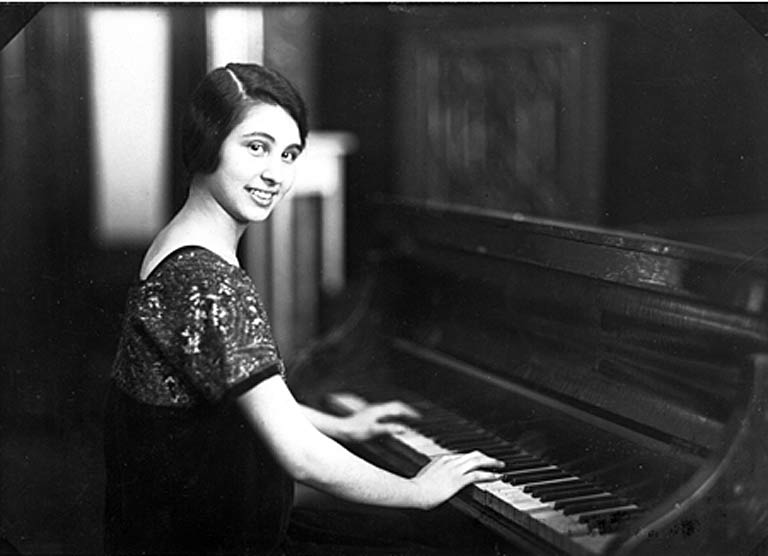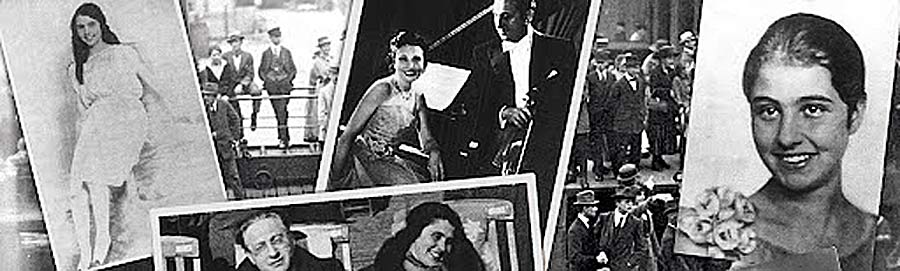
When Heida Hermanns fled Germany in the 1930s, she did not leave with only what she could carry. She left with two grand pianos (one of which she had won in a competition), along with her paintings, her furniture, and her dishes.
When you think of fleeing, it typically does not include grand pianos, notes Anneruth Serman, who worked alongside Hermanns for years at the Westport Arts Center, now MoCA\CT. “But Heida did everything on a grand scale,” she says.
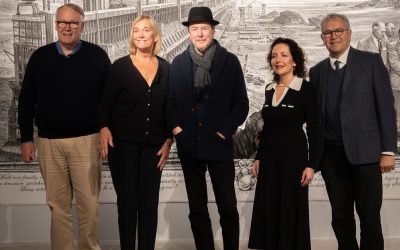
On November 14, the 54th annual Heida Hermanns International Music Competition returns to MoCA\CT for the Final Round, where three promising and accomplished classical pianists will compete for the $20,000 first prize and a solo recital engagement at MoCA\CT. Ahead of the evening, we asked friends of Hermanns (who passed away in 1995) to share their memories of the remarkable woman behind the competition that bears her name.
“That’s Heida”
Serman met Heida at church in the 1980s, and soon learned how her friend’s days began. If the telephone rang at seven in the morning, Serman’s husband would roll over and say, “Oh, that’s Heida.” It always was. “She would say, ‘I was thinking about what you could do today.'”
Declining was not an option. “We tried that a few times, and it did not work,” Serman says. “We ended up doing it anyway, so you might as well say yes from the beginning.”
MoCA\CT Executive Board Member Elizabeth Strick remembers the late Joyce Thompson, former three term president of Westport Arts Center, saying when she walked into the office at 9 am, the phone would always be ringing. It was Heida, who often supplied the vision and expected others to supply the legwork. She would contribute money to a project, but never all of it; the rest was theirs to raise. “In Heida’s world, everything was possible, which was inspiring,” says Strick.
Much of what she set in motion was built for artists. When the town leased the old Greens Farms School to the Arts Center, its classrooms became studios for some painters, sculptors and writers. Heida inspired, and largely funded, the conversion of a large open space with a small stage and movable risers in memory of her husband, Artur Holde Hall. The much used performance and exhibition space also hosted art shows and even a children’s opera. “It was a well-used and popular event space in Westport,” recalls Serman. “A lot of things happened there.”
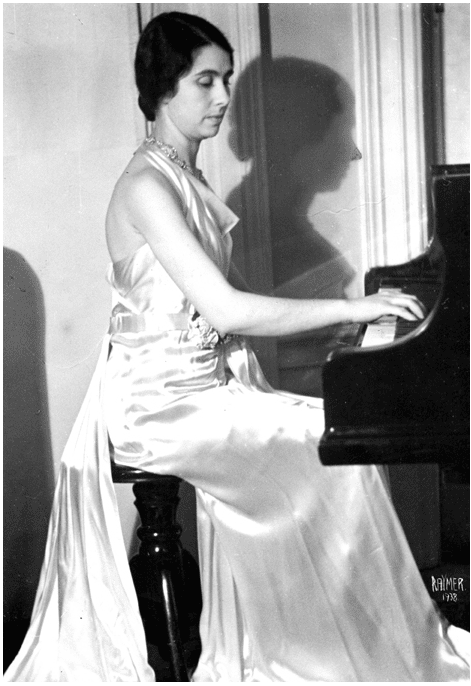
An undated photo with Heida at the piano
A Pianist First
Music was the center of everything. Born Hedwig Goldschmidt on October 14, 1906, in Wiesbaden, Germany, Heida grew up in a German-Jewish family that considered Germany its homeland. Her mother, Alice Metzger, a gifted pianist, gave her first lessons.
At fourteen, she debuted with the Wiesbaden Symphony; at fifteen, she entered the Berlin Hochschule für Musik. Her teachers included Egon Petri, Artur Schnabel, Carl Friedberg, and Isabella Vengerova. By eighteen, she had debuted with the Berlin Philharmonic and was touring Europe as a recitalist and soloist. She adopted her aunt’s surname, Hermanns, to avoid bias against her Jewish name.
In 1932, she married the music critic Artur Holde. As Nazi persecution intensified, she performed for the Jewish Kulturbund while Artur edited Jewish newspapers. After the Nuremberg Laws, the couple fled on visitor visas, arriving in New York on October 16, 1936.
For all the possessions she brought, their early years in America were difficult. They spoke little English and lived in poverty, sharing a single cup of tea. Heida practiced in a hotel lobby and taught at the Y School of Music and the Chatham Square Music School. After a trip to Cuba in 1937 to reenter the country legally, they became U.S. citizens in 1942. They also brought her parents and their sisters out of Germany.
In New York, Heida continued her studies with Pierre Luboshutz and Vladimir Dukelsky, while Artur became Aufbau’s music editor. She performed widely, including at Carnegie Hall, and concertized in a duo with John Corigliano Sr.
In the late 1940s, fear of nuclear attack led the couple to Connecticut. They settled in Westport, where Hermanns taught at the Westport Music School and helped found the Friends of Music chamber concert series.
A Sense of Purpose
After Artur’s death in 1962, she turned her grief into purpose, devoting herself to the next generation of musicians. She taught at the Manhattan School of Music for ten years and then founded Performers of Connecticut to create performance opportunities for young artists. She also established the Heida Hermanns Young Performers Competition, known today as the Heida Hermanns International Music Competition.
The competition she founded once included winds, strings, and voice. Each category needed its own judges, and every year brought the same debate over which instruments to feature, until Hermanns settled it herself: “Make it piano and be done with it.”
Age didn’t slow her down. In her later years, even when she was confined to bed, she ran things from there with a stack of index cards and a telephone, and by evening everyone was organized and moving. As her friend and associate John Vaccaro, recalls, “She accomplished more from her bed than other people accomplish in a day at the office.”
Her friends remember her as tiny, barely able to see over the steering wheel, and the sweetest person you could meet. But also according to many, “a force to be reckoned with.”
Vaccaro recalls when Heida heard that his first child was born, the elderly Heida immediately hopped in the car. “Heida drove to our home in Weston after dark just to hold our baby,” he says. “She showed up wearing cowboy boots, which was kind of the way in which she rolled.”
Continuing Her Work
Toward the end of her life, Hermanns made a simple request of those around her: “If you love me, continue my work.”The competition has done exactly that, growing from a local event into an international one.
Audiences once sat through three days of performances; now the finals bring three pianists to the stage in a single evening. The competition has been a launchpad for many winners, who have been finalists in competitions around the globe, including the Van Cliburn Competition, the Dublin Competition, Gina Bachauer International Piano Competition, Cleveland International Piano Competition, and the Santa Cecilia Competition in Porto, among many others.

The 2026 Heida Hermanns International Piano Competition Finalists
This year, the finalists include: Matthew Figel, representing the United States; Juhee Lim, from South Korea; and Daria Podorozhnova, from Russia.
“She would be very proud that it continues,” Serman says.
Join us on Saturday, November 14 to experience the next generation of classical piano, and the young musicians keeping Heida’s dream alive.